Week 274: London to Athens via Rome (and a few other places)
The London Okinawa Sanshinkai was invited to perform at Japan Festival Greece in Athens on the Easter weekend – our Easter, that is; Orthodox Easter as celebrated in Greece falls a week later this year – and I decided to take part. L— and I chose to make a proper holiday of it: rather than flying to Athens, we’d take the long route by train and ferry, and stop off at some other places along the way. The itinerary, travel, and hotels were all organised by Byway, who we used to arrange our trip to the Basque country last year, using their concierge service. It wasn’t cheap, but it wasn’t all that expensive either, considering that it included travel, hotels, and first class upgrades on most of the train journeys. It was also very easy and almost certainly cheaper than the nightmare of administration that booking it ourselves would have been.
Our outbound itinerary was one night in Turin, two nights in Rome, and one overnight ferry before arriving in Athens on Friday.
We left London on Monday morning. We started with the long queue for the Eurostar at St Pancras (just behind the first example of Mar-a-Lago face I’ve seen in the flesh, and very disturbing it was). From Paris Gare du Nord, we took the RER to Gare de Lyon and, from there, a Ouigo TGV to Turin.
Paris remains an annoying hold-out as the only place we visited where you can’t just use a contactless bank card to travel, but instead need a special card (Navigo) that you have to reload. Everywhere else, even on the diminutive Turin Metro, you can tap a card you already have.
The TGV gets as far as Lyon rapidly, but then spends hours crawling across the Alps on slow lines. We left London in the sunshine, but up in the prematurely crepuscular shadow of the mountains it was snowing.
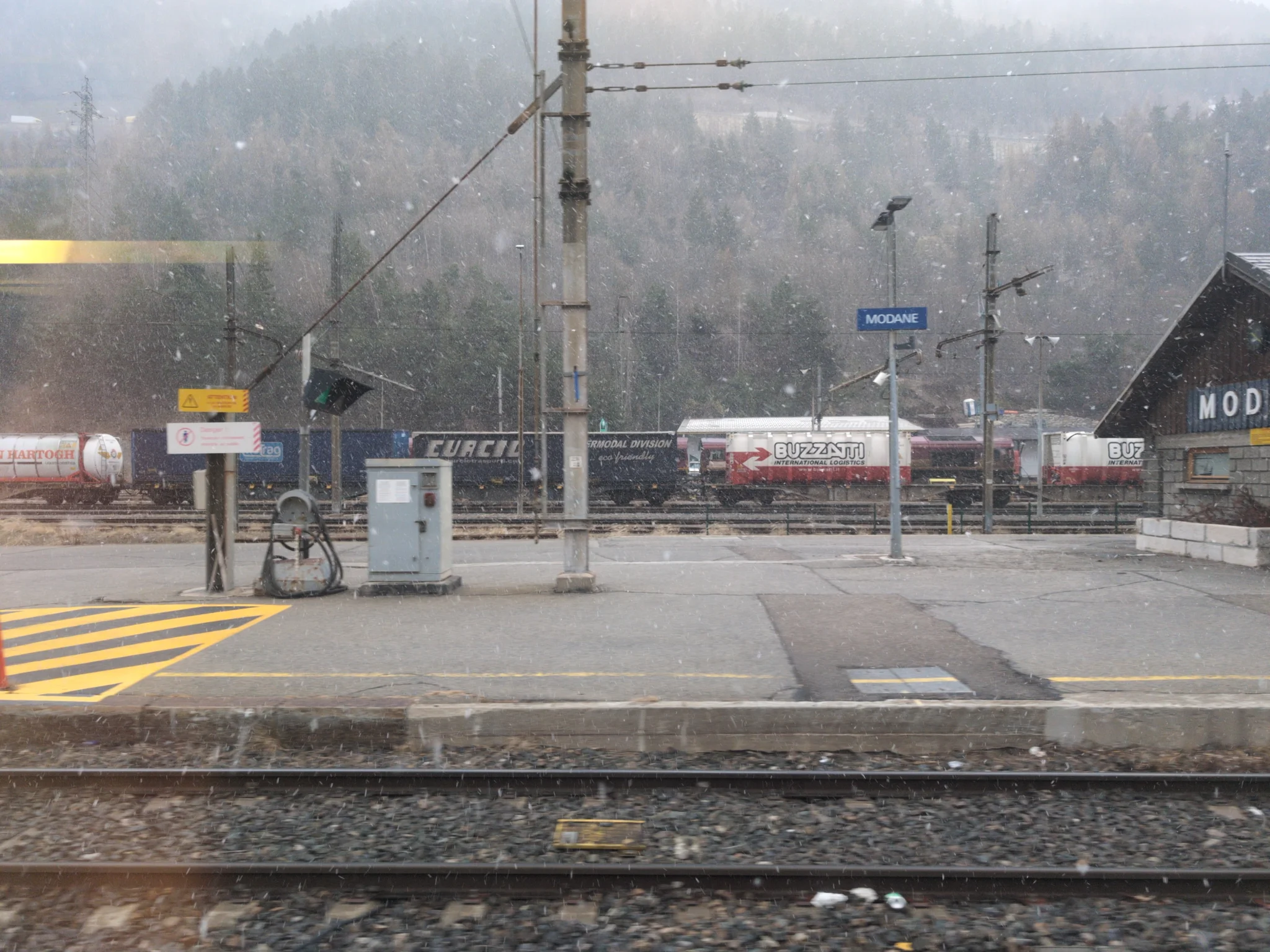
Snow in the Alps
We broke through back into daylight on the Italian side and arrived in Turin in time for dinner at Gørilla, a characterful bar with plenty of vegan tapas options of which we ate our fill.
Although we were only in Turin for the night, after an early breakfast in our hotel next to the station we had time to wander around the city for a couple of hours before our 09:55 train to Rome.
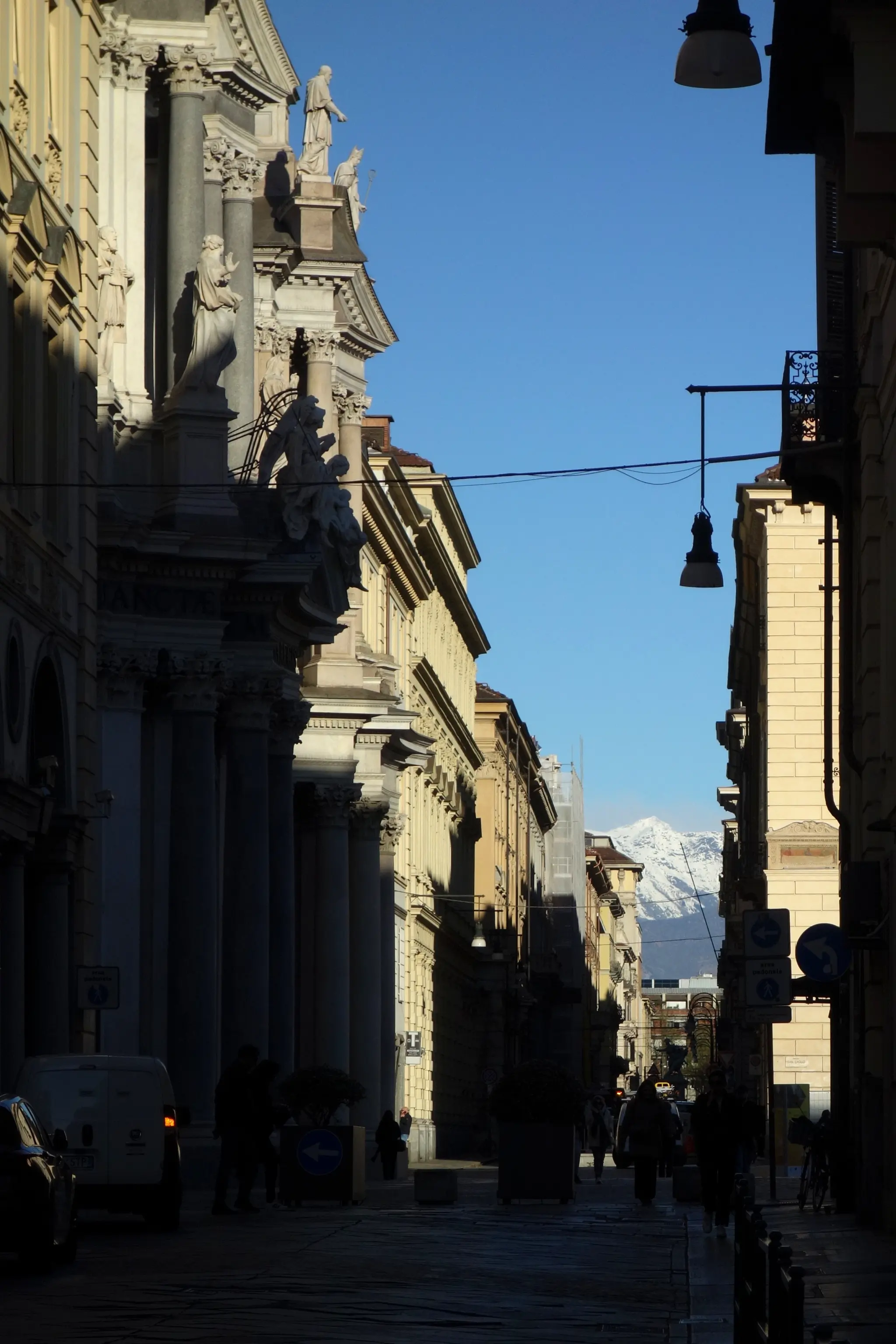
Turin and the mountains behind
The Frecciarossa to Rome to was fast (295 km/h), it was reasonably comfortable, and it arrived on time in the mid afternoon.
Rome underwhelmed me, however. Whatever illusions of la dolce vita you might harbour, dispel them. There is plenty of historic architecture in various states of ruin, but the overwhelming theme of Rome is cars. Perhaps it’s connected to the fact that the metro network is so desultory, but every space that isn’t filled with as many lanes of traffic as they could squeeze between the buildings is given over to static cars parked double or even triple. We walked the Appian Way from the Parco della Caffarella to the Colosseum; for most of the route the cobbled street is two lanes of speeding vehicles, with only a narrow painted-on strip for pedestrians on each side.
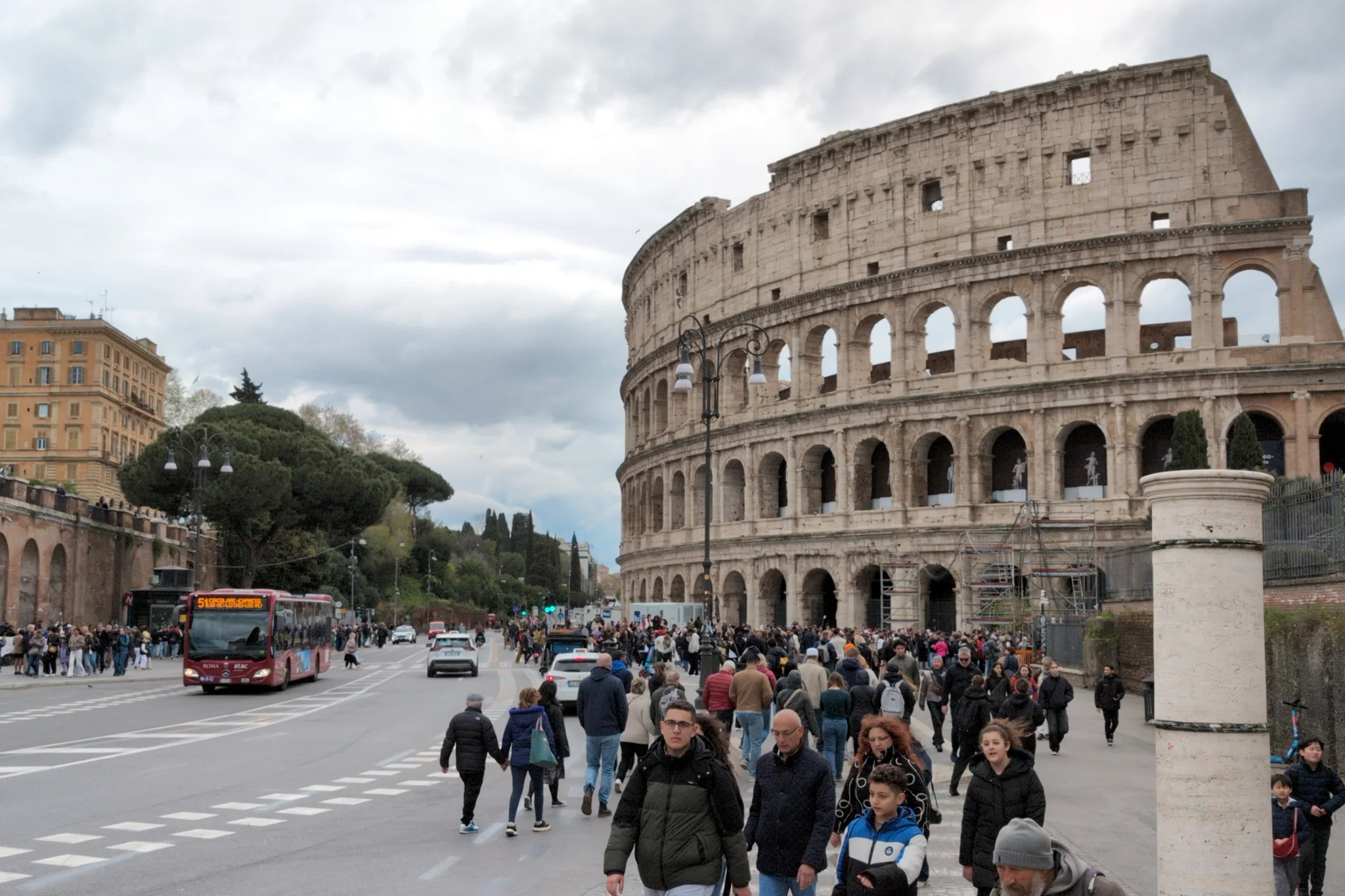
The Colosseum in its context
The city is also crowded. By the raw numbers, there aren’t as many tourists in Rome as in London – fewer than half as many visitors, in fact – but because they seem to be squeezed into a smaller number of places it feels much worse.
We decided not to squander our limited time in Rome in any of the queueing opportunities, so we enjoyed the Colosseum and Palatine Hill from the outside. I would, however, recommend the placid, tourist-ignored, and free Museo delle Mura in the Porta San Sebastiano, in which you can learn about the old city walls and walk along a section of them.
The churches are worth looking inside; for example, amongst all the scaffolding and repairs in Santa Maria in Portico di Campitella is a stunning 17th century altar:
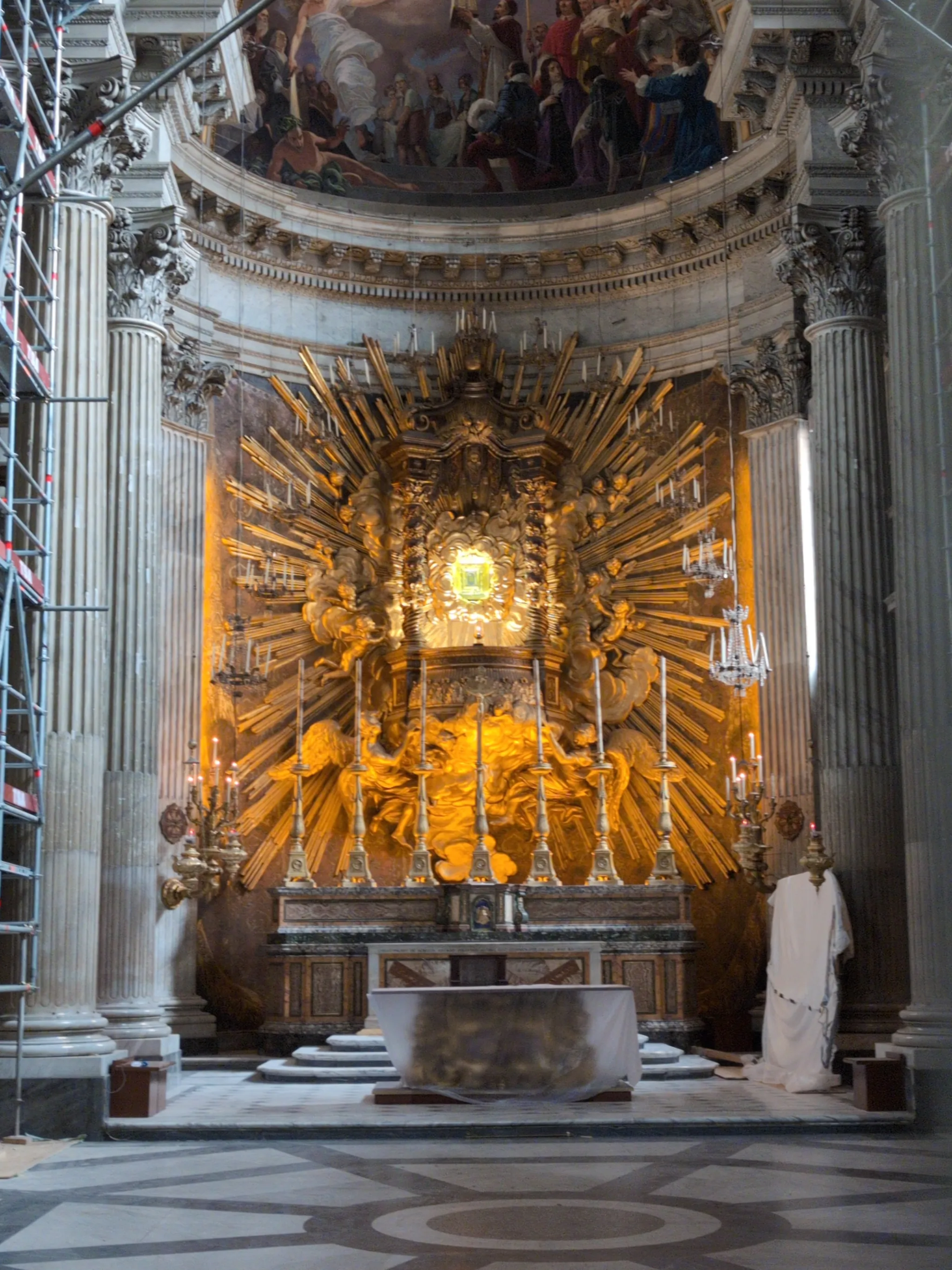
The golden altar of the church of Santa Maria in Portico
Our hotel was in the south of the city, in the Garbatella area, where we found Le Bistrot, an amazing vegan restaurant, run by a friendly family, serving adapted versions of traditional Roman and Italian cuisine.
To get to Greece we first took another Frecciarossa to Bari on Thursday morning. After a stop for a coffee, We walked through the old town in the rain to the port, followed the long and perfunctory pedestrian route to the terminal, and checked in for our ferry to Patras.
The ferry (Superfast II) was fairly new and well appointed, and our room was comfortable enough for a good night’s sleep disturbed only by the alarming reverbrations of an intermediate stop in the wee small hours at Igoumenitsa.
For most of the journey the ferry is within a short distance of the coast, so to avoid the exhorbitant roaming charges of the marine base station on the ferry itself, I turned off automatic network selection and fixed my phone to an Italian network (and to a Greek one the following morning), and had a working connection most of the time using my regular free roaming allowance.
The journey from Patras to Athens was more of a hassle. First, we had to get from the ferry terminal to Patras itself. There are some intermittent buses, but the easier way was a taxi for €10. There’s a railway station at Patras, but you can’t get a train to Athens from there. Instead, you take a bus operated by the railway company as far as Kiato, from where the train to Athens departs. We’d been told to take the bus from the bus station across the road, but when we reached the bus station we discovered that it was abandoned, replaced by a newer bus station a few minutes further on. But there was no sign of our bus on the departure board, and when I asked at the information desk I was rudely informed that it was another company and they didn’t know anything about it.
We walked back to the railway station, and found our bus parked in front. It took us to Kiato, we changed to the Athens train (operated by Hellenic Train, Ferro dello Stato Italiane Group, like it’s still the early Roman Empire), and then caught the metro a couple of stops to our hotel, where we arrived about 18:15 on Friday evening.
And then I immediately left again to go to the venue for a soundcheck, while L— took our dirty clothes to a serviced laundry to be washed and dried for €10. It’s much easier than carrying around a fortnight’s worth of clothes.
Athens is a lively place in the evening. We strolled to Exarcheia to COOKooMÈLA for delicious vegan souvlaki and generous cups of wine (⅓ of a bottle for €3!) at a table on the pavement in front.
The Sanshinkai performance wasn’t scheduled until late on Saturday, which left us plenty of time to wander around Athens, visit the Museum of Ancient Greek Technology (fun and interesting), see some of the sights like the National Garden, the Zappeion, the Temple of Olympian Zeus (we didn’t go in as it’s half covered in scaffolding and you can see it pretty well from the fence without paying €20 a head) and the Arch of Hadrian, wind our way through Plaka and Monastiraki, and still have a few hours for a nap before heading to the venue.
I found a music shop selling traditional instruments and tried several baglamades of various prices before choosing a mid-range one that was easy to play and sounded good to my ears. It’s one more thing to cart with us on our journey back, but at least it’s small and light: it’s specifically designed to be that way.
Our performance went well. Everyone knew what they were doing, nothing broke, and the audience seemed to enjoy it. The taiko players didn’t bring the bulky drums from London, but instead borrowed a couple from a Japanese percussion group in Athens. Unfortunately, Japanese taiko drums are designed for static use, rather than being carried by dancers, and these were about twice as heavy as they were used to! They managed, but I don’t think it was fun for them.
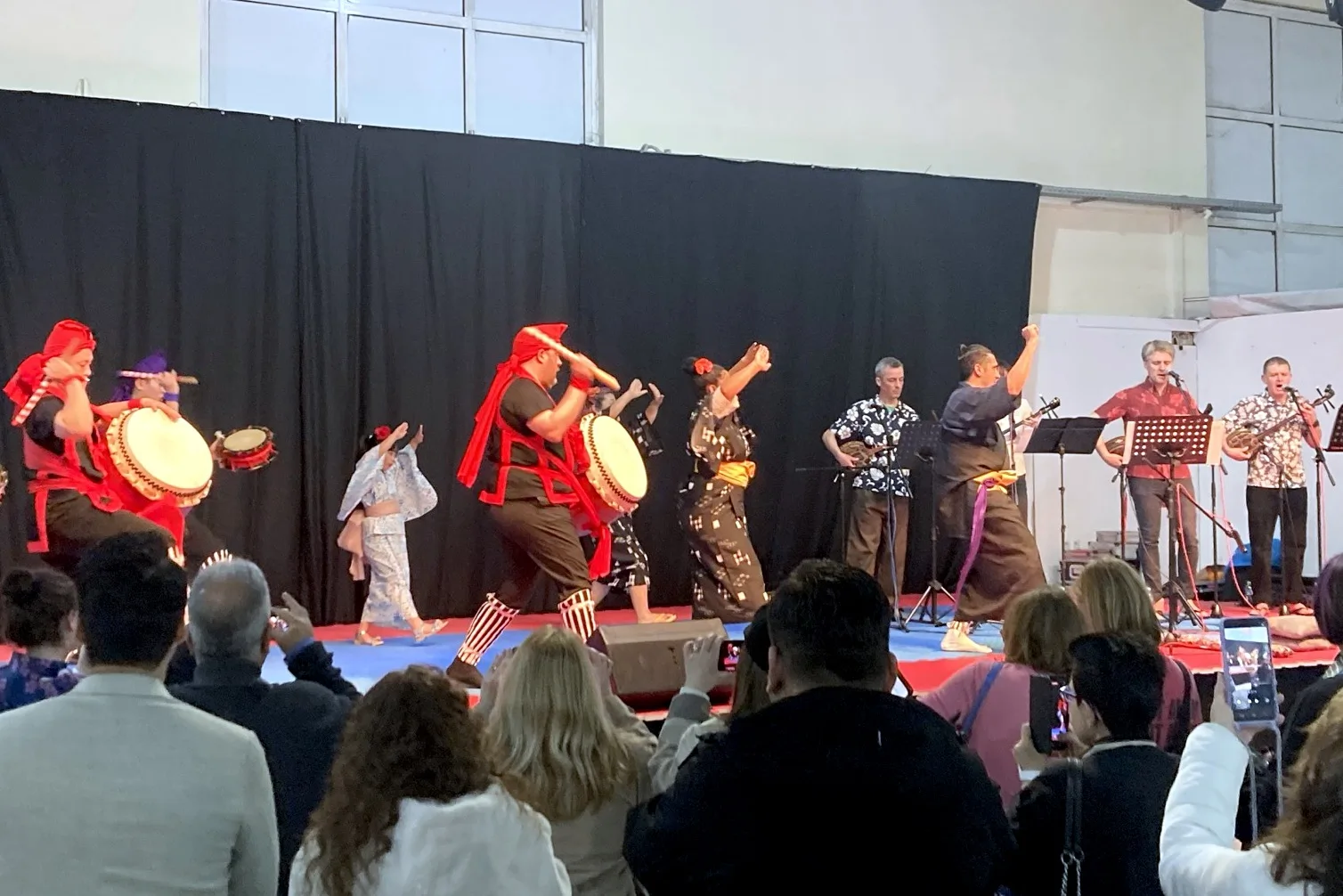
Performing in Athens
Early on Sunday morning L—, I, and most of the Sanshinkai performers climbed up to the Acropolis in time for the 8am opening. The Ministry of Culture had given us free tickets in exchange for our participation in the cultural life of Greece, but the gate staff at the Acropolis, in full jobsworth mode, were having none of it. “Why do you have free tickets?” Because your government gave them to us. After our Greek member went to talk to the ticket office staff, who didn’t have any problem with it, we eventually made it inside.
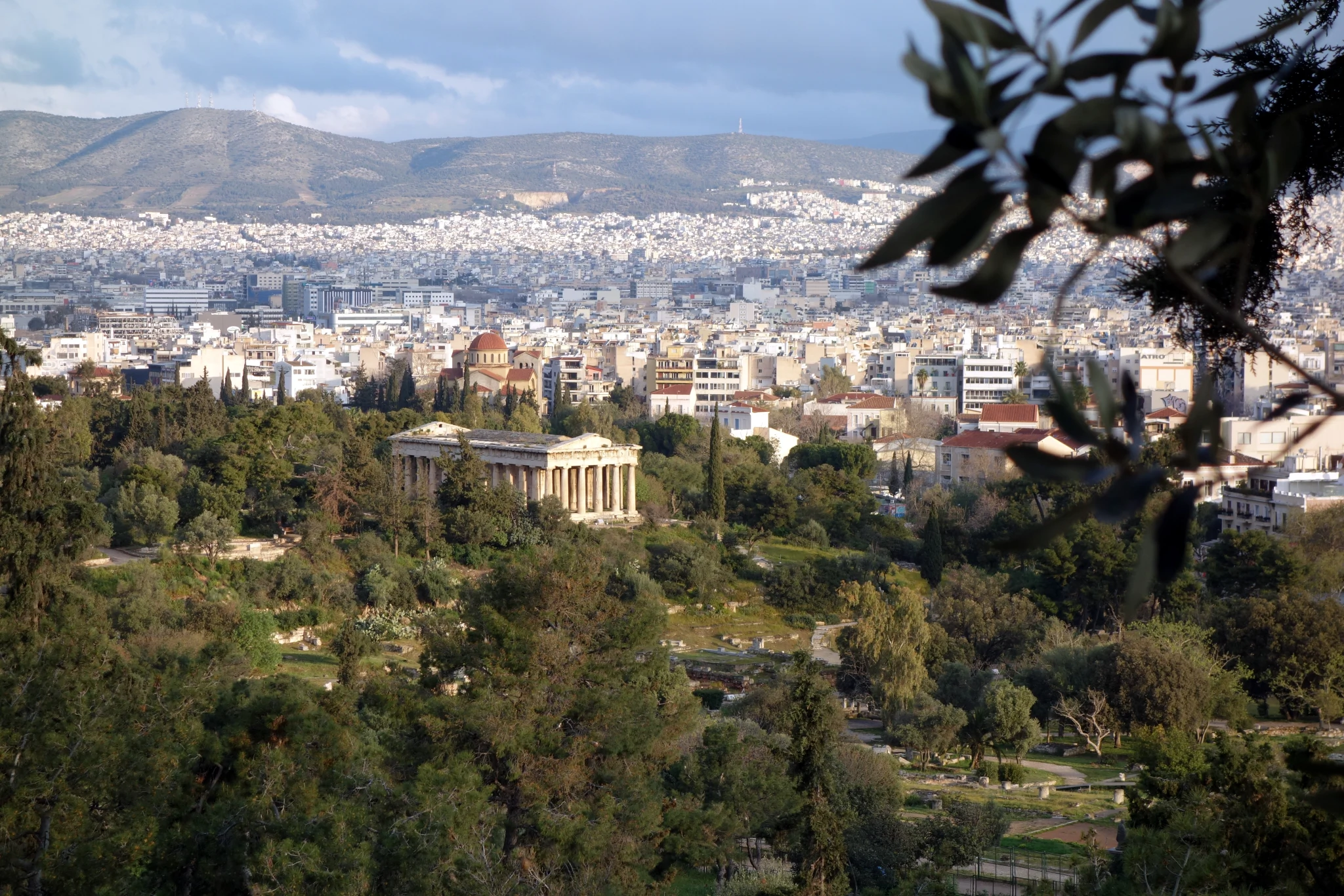
The Temple of Hephaestus and the modern city
Compared to Rome, even the most important sites in Athens are fairly quiet, especially first thing on a Sunday morning. We took a relaxed wander around the Parthenon and its environs before walking back down the hill to the Acropolis Museum for brunch and a look at the exhibits.
The museum’s presentation of the Parthenon sculptures is excellent, and further reinforces the inescapable truth that the ones that Elgin appropriated would be better returned to their proper context, rather than continuing to sit in a gloomy room in the British Museum.
I liked Athens a lot, although I’ve never been anywhere quite so noisy. We gave up on the idea of eating at one restaurant because the techno emanating from a bar a street away was so unpleasantly loud – more appropriate to a warehouse in an industrial estate than a residential street – that it would have been like dining next to a pneumatic drill. The bar next to our hotel was similarly loud, but luckily our room faced an internal courtyard and was insulated from it.
Sunday was our last full day in Athens; the journey continues in the next installment.