Week 299: Tree walk
L— and I met an old friend on Tuesday night for some drinks (al fresco at The Rake near Borough Market) and a lot of chat. We had several years to catch up on. The lesson is that if you haven’t seen a friend in ages, even if that’s because they live far away and don’t come to London for work any more, and you’re thinking of them, send them a message.
Thursday evening was perfect weather to wander around Russia Dock Woodland looking at trees with s group of people led by someone from the London Wildlife Trust. I can now tell you the different between a field maple, a Norway maple, and a sycamore, and I can distinguish an aspen from a white poplar.
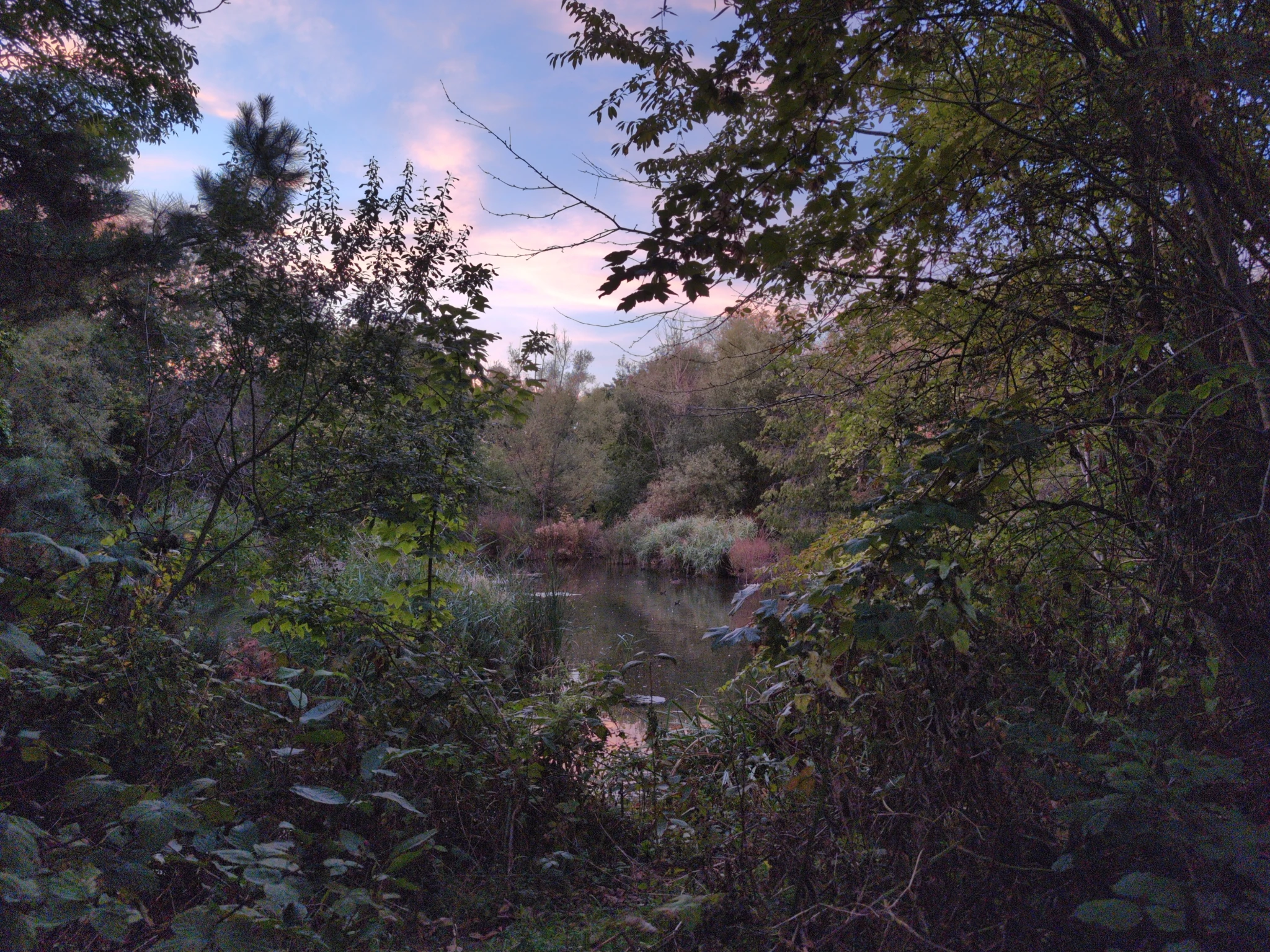
Urban idyll (Russia Dock Woodland on a fine autumn evening)
I wrote to my MP expressing my displeasure at the apparent legal immunity enjoyed by Daniel Thomas and his organised, uniformed gang of masked fascists after he blocked the port of Dover, gathered a mob to attack and interfere with RNLI volunteers, and filmed himself deliberately damaging a boat with someone aboard. I pointed out several potential crimes that attract custodial sentences, and compared this unfavourably with the treatment being meted out to pensioners holding cardboard signs supporting Palestine Action.
The next day, he was arrested, but I’m sure my useless MP had nothing to do with it.
The police are still arresting people for holding signs, though.
Our digital kitchen scales stopped working right as I was about to make
bread on Saturday morning. Instead of anything useful, all they show is out2,
which seems to indicate some kind of calibration problem. I had to buy a new
set, but I still have the receipt from the old ones, so I’m going to try to
take advantage of that 15 year guarantee they offered.
I made the dough last night, using the new scales, and baked it today. The loaves came out perfectly.
I like to read French novels occasionally in order to keep in practice. I enjoy literary fiction, and I use the Prix Goncourt as a selection of things that might be worth reading. 2020 winner L’Anomalie by Hervé le Tellier is a fun experiment in fusing together multiple styles, including a jarring section of airport-thriller schlock in the middle. 2021’s La plus sécrète mémoire des hommes by Mohamed Mbougar Sarr is a deep, layered, immersive, often confusing web. 2022’s Vivre Vite by Brigitte Giraud is a poignant exploration of loss and of self-recrimination, and of the “if only” moments that could have averted an accident. I haven’t picked up 2023 or 2024’s winners yet, which is clearly an oversight on my part.
I’ve been paying attention to the case of Thélyson Orélien, the Haitian-Canadian novelist whose book C’était ça ou mourir, which won the Prix du roman Fnac and was one of the 2026 Prix Goncourt selections, is alleged to have been substantially authored by generative “AI”. This has been followed by others digging into his published work to find other transgressions, in an unpleasant echo of how Jason Arday was targeted.
This does appear to be another case of a successful black person being targeted by racists. The allegations may also be correct. Radio-Canada has a detailed article (in French) based on interviews with experts and on their own experiments that test various objections to the Pangram-supported assertions.
However, I think that Mohamed Mbougar Sarr’s response says it best (I translate).
I don’t know whether Thélyson Orélien used AI for this book. I don’t venture onto that terrain. But it seems important to me, even if you have doubts, even if you have, like me, not been touched by this novel, to defend the author against the ideologically facile and malicious part of the accusation. […] If the partial or complete use of AI in the writing of C’était ça ou mourir comes to be proven, then, whilst deploring and criticising this usage on principle – because I believe, in my old-fashioned way, that the pride and honour of an honest author consists in writing alone, even if they are never alone, I will continue nonetheless to defend the author against racist attacks. It must be possible, in my eyes, to hold these two positions.
Horrifying discovery of the week: the concept and practice of the daily standup has escaped containment, and people in non-software fields are now being subjected to the awful quotidian ritual. I can only apologise for my part (albeit unwitting) in the establishment of this terrible observance.
I keep getting spam emails from bots promising to help me promote various of my open-source repositories. I have responded to each one with the full script of Bee Movie.
After being pointed in the direction of Geneva drone-folk band La Tène and listening to some tracks, I ended up ordering a shruti box. I’d had a tab open for about 6 months, so it wasn’t entirely impulsive. Anyone want to get together and make some weird acoustic music?
This week’s links:
- Z80 Assembly: “This document is intended for everyone who wants to learn Z80 programming in its depth.”
- One month without AI: “I went back to TDD, to my PRs with just 5 files changed. To my 2-line PR descriptions that were straight to the point. I went back to understanding what I was doing, to deploying with confidence, to being ready for a detailed code review, because I knew what the changes were doing, and I could justify every line of code.”
- cgit as an Unintentional Honeypot If a crawler is hitting an old commit in an old fork, it’s probably a bot; here’s how to ban the IP address with fail2ban.
- LLM Policies: Progress At All Costs. “Unfortunately this ‘expert slop’, where expert is a self-perceived title, carries a corporate framing that damages interactions. Others become, at best, fungible coworkers, and, at worst, annoying speed bumps in the race to 100% completion of any software interest the expert has. No more mentoring, debating, flame wars. ‘Progress’ is the only goal. The line must go up.”
- AI Workers’ Inquiry 2026: “The UTAW Tech Workers’ Inquiry outlines how generative AI is changing work across the tech sector, written with the perspectives and experiences of workers who build, deploy, manage, evaluate and use this technology.”
- With hollow feet and harlequin hats: Tuscan letters, a prank of lapidary origin? “Basically, a typeface is considered Tuscan when its serifs are bi- or tri-furcated (sometimes with a greater number of extensions) to achieve a certain degree of fantasy or ornamentation.”