Week 290: … and back again
Strictly speaking, I didn’t have to cycle all the way back from Electromagnetic Field – I could have cycled as far as a convenient station and taken a train the rest of the way – but I was mentally committed to finishing what I’d started.
After a reasonably early bed and an adequate night of sleep on Sunday night, I woke, ate breakfast in my tent, packed everything onto my bike, and left the festival site a little after seven o’clock. My first day’s route was 86 km with 860 m of climbing.
I saw wrens, corncrakes, peacocks (and peahens), a dunnock, some birds of prey I couldn’t identify (buzzards, perhaps), some I could (red kites), and some unexpectedly excellent cycling infrastructure in Gloucestershire outside Cheltenham.
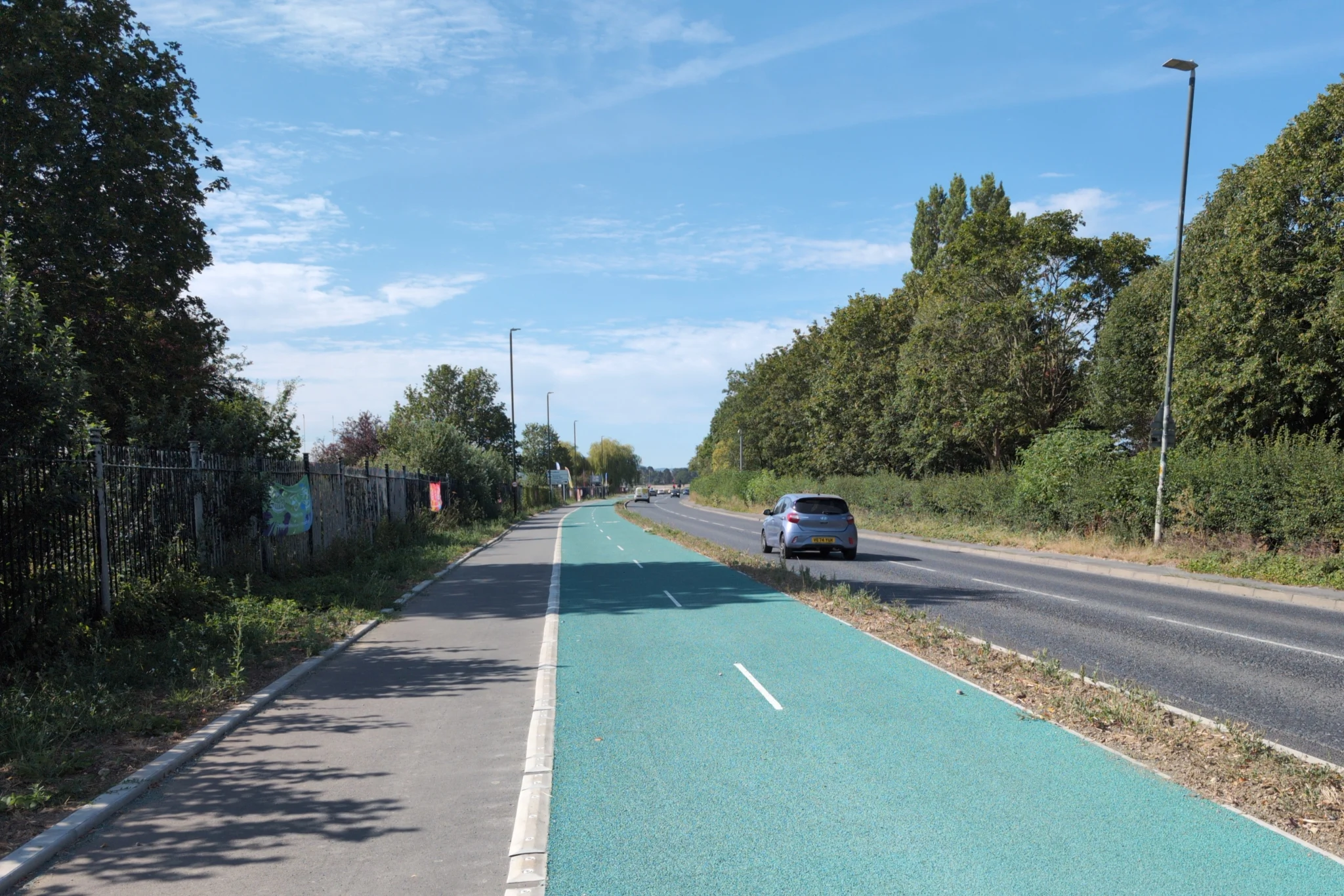
Good cycling infrastructure
I had to attack one particularly steep hill in 10 m bursts, but I loved coasting down the other side at over 50 km/h.
I imported my maps from cycle.travel into Organic Maps, but made the mistake of allowing it to suggest a slight variation that looked better on the map. This turned out to be impassable to anything less than a lightweight mountain bike, and I had to take a significant detour.
For lunch, I ate a carb-on-carb feast of hash browns in a bun in a café in an old prison.
My campsite for the night was basic but comfortable. My tent attracted hundreds of flying ants. I managed to keep most of them outside. The site was close enough to RAF Fairford to see and hear a few fighter jets, but they didn’t keep me up at night. In fact, it was my first night camped on a level pitch for a while, and I slept better for not sliding down towards my feet.
My second day of cycling was long: 150 km with about 660 m of climbing. I reasoned that, as a shorter distance would have taken me to the outskirts of London anyway, I might as well push on all the way home to a real bed. In the worst case, it would be possible to catch a train into the centre.
On my way back along the Oxford–Witney bypass cycle track, I stopped off again at Greggs for a morning coffee and vegan sausage roll, and sat on the ground enjoying it. Greggs’ coffee is cheap and, in my opinion, a lot better than many actual coffee chains. Even I, a notorious coffee snob, find it drinkable, which is not something I could say of Costa or Caffè Nero.
I encountered a 15% incline after Princes Risborough that I couldn’t ride up. I had to push my loaded bike to the top, taking frequent breaks, dripping with sweat. But I made it, and from there it was mostly flat as far as the pub I’d targeted for lunch.
The pub kitchen was closed on Mondays and Tuesdays, unfortunately, but I bought a drink and sat in the garden eating my own food with their blessing. As I chatted with the regulars, I learned that Kop Hill, the hill I’d just conquered, was the venue for a motor vehicle hill climb challenge. I assume that “Kop Hill” is another one of those tautological place names that just means “hill hill”. It’s definitely a hill.
There was another impossible hill immediately after Great Missenden, on a
dirt track which reaches a vertiginous 19% gradient. I struggled not to slide
back down the hill as I pushed my bike. This particular track (along with Kop
Hill) is on Sustrans the Walk Wheel Cycle Trust’s National Cycle
Route 57, which goes to reinforce my negative opinion of that organisation:
they proclaim all these cycle routes that they have “created”, but it most
cases their work seems to be limited to the addition of hard-to-see signs on
routes that aren’t always practical or even safe for cycling.
Mindful of the effort of the gravel section on my first day outbound, I chose a “tarmac” route for my return into London. This took me along a safe but unpleasant track alongside the A40 for what felt like a long time, until I was able to duck through some small streets and get onto the Grand Union Canal all the way back to Notting Hill. From there, I rode through Kensington Gardens and Hyde Park by the light of the evening sun, then the familiar streets of south London, then home.
A new fresh hell is upon us: “vibe gardening”. When the garden company came round for an initial visit and chat, they showed me an example of a garden design: to scale, drawn by hand on squared paper. They quoted an initial price to make the plan.
What they delivered was a series of fancy looking renderings, each of which was accompanied by a top-down view that didn’t match the rendering, and neither matched the actual size and shape or the positions of doors and gates of either our front or back garden.
We began to suspect the malign claw of “generative AI”, and our suspicions
were confirmed when they sent us a link to an image with impossible geometry
and chatgpt.com in the URL. We have asked for our money back.
The thing that saddens me is that, a few months ago, these people were probably competent at their jobs. But a short period of exposure to the obsequious confabulating device has left them unable either to make a simple plan, or to recognise that what they are producing is completely unfit for purpose. It’s a deskilling of disturbing rapidity.
My advice is, never talk to the machine. When billionaires, politicians, and bosses want you to outsource your thinking to the machine, the best resistance is to keep thinking for yourself.
I answered a call from an unrecognised number on Thursday. A robotic voice just said, “Goodbye”, and hung up. The machines are onto us.
Khan’s Bargains is open again. The most useful shop in south London has been closed since the store room fire a few weeks ago, and I’ve missed it.
I’m one of those people who discovered a few years ago that most of the population can literally visualise things, and that the mind’s eye isn’t just a metaphor. I was astounded to learn that “counting sheep” involved enumerating perceived sheep, and not just counting up from one like you’re playing hide and seek.
However, as I lay in bed on Friday morning, awake but only just, I found myself imagining an apple; as I concentrated I was able to see it in colours of red and green, and even to feel the texture and smell against my face. I was awake, but perhaps I was still close enough to dreaming, or perhaps aphantasia is a thing that can be overcome.
I got a letter from the government the other day; I opened it and read it, it said they were … going to send me a load of money. The work I did for the Department for Education was paid through a complicated arrangement involving multiple intermediary companies. Because I finished in the middle of a tax year, they didn’t supply me with a P60 end-of-year calculation, and I had to reverse engineer it from my pay slips. Evidently, I made a mistake, because they did send the calculation to HMRC, and I had paid more tax than I thought. Someone at HMRC corrected my tax return, told me I was owed a refund, and £5,800 appeared in my bank account the next day.
We both volunteered to work as stewards at London Trans+ Pride again this year, after a year in which trans people have been subject to more attacks from society, the state, and one particularly rancid billionaire.
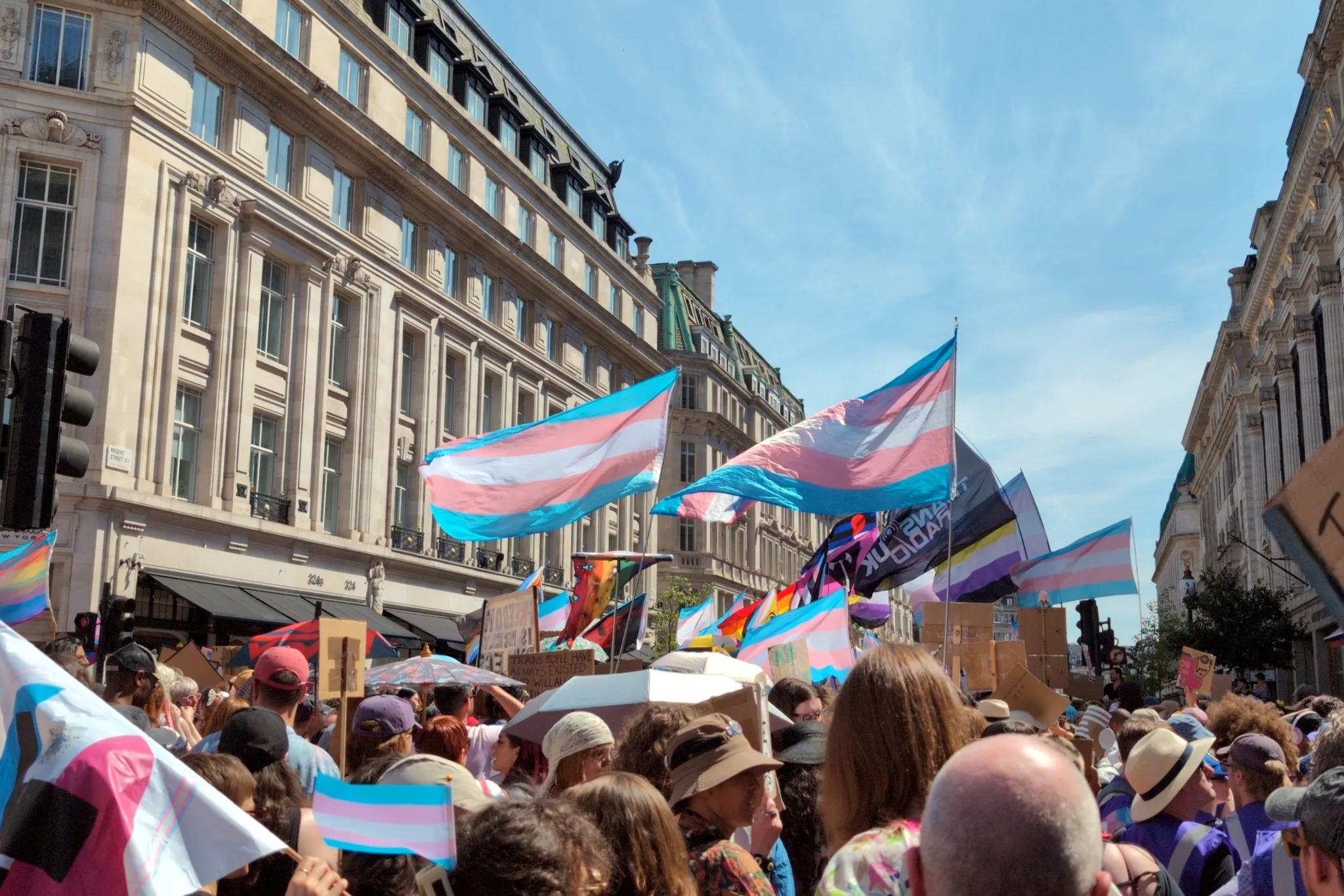
London Trans+ Pride
Last year, the turnout was estimated at 100,000; this year, it was about 150,000 trans people, their families, friends, and other allies.
Trans people are a small minority of the population, but you’re not alone. A lot of us will stand with you.