Manifesto for Greater East Asian Co-operation
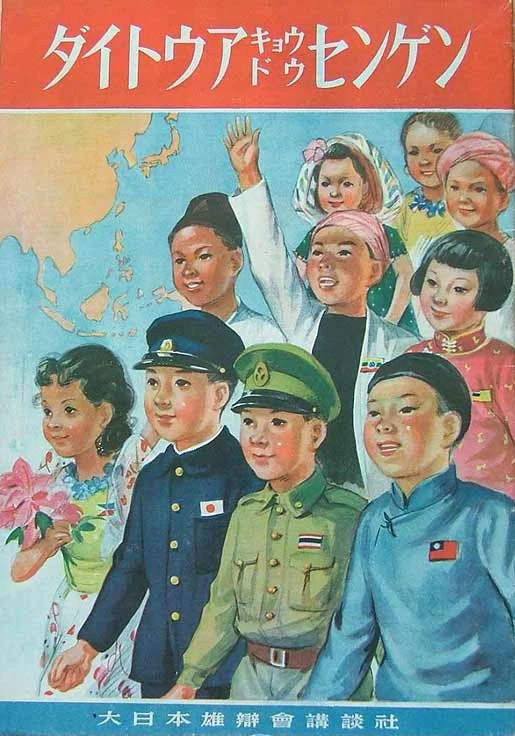
Preface
The original images are from 2bankok.com, where they are presented as scanned images with some annotation. I thought that a translation into English would be informative, so I took it upon myself to do that.
The original is obviously aimed at children, judging by the small number of kanji it uses. From my point of view, that actually made it harder to translate: the pre-war spelling—especially of Chinese loan-words—is markedly different to the modern orthography. I’m also unsure of which of several possible homonyms were being used in some of the titles, so I have translated those rather less accurately than the rest of the text. The sentences, however, are very short and simple, and I believe that my translation of the text is pretty accurate.
Before
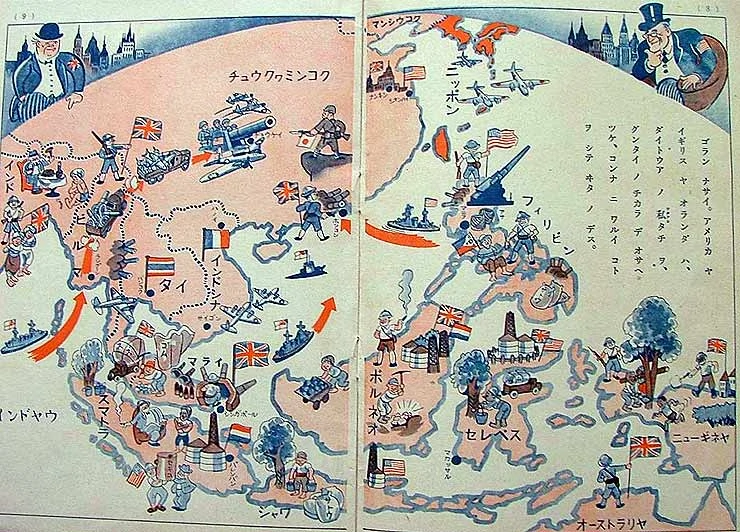
Look! Using their military might, America, Britain and the Netherlands have done all these bad things to us.
After
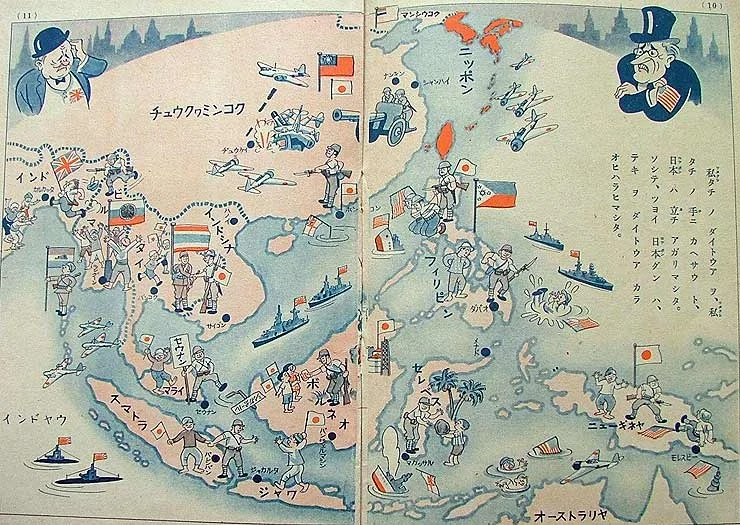
Japan has woken up, and returned our East Asia into our own hands. Japan’s strong military has driven away our enemies.
Independence and Harmony
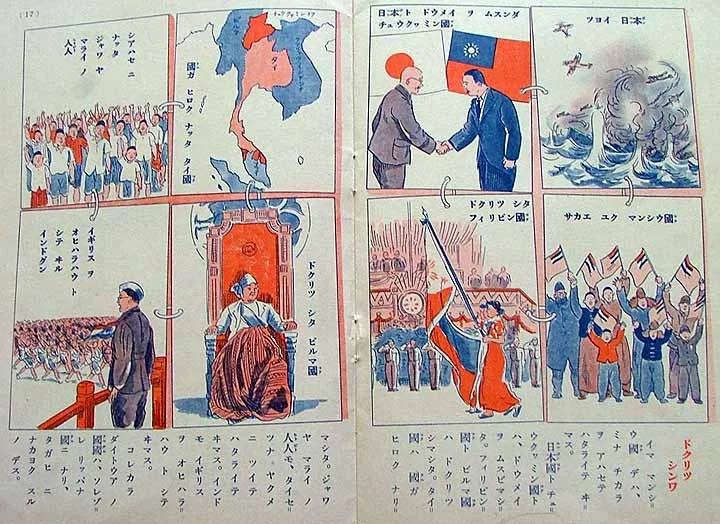
Right now, in Manchuria, all the people are combining their strength and working together.
Japan and the Republic of China have formed an alliance. The Philippines and Burma have attained independence. Thailand has grown larger. The Javanese and Malays, too, are working on important business. India is driving away the British.
Next, the countries of East Asia will form a union and become a great power, friendly to one another.
Captions
The image captions are listed top-to-bottom, right-to-left:
| 7 | 5 | 3 | 1 |
| 8 | 6 | 4 | 2 |
1. A strong Japan.
2. A flourishing Manchuria.
3. A Republic of China in alliance with Japan.
4. An independent Philippines.
5. An expanded Thailand.
6. An independent Burma.
7. Happy Javanese and Malays.
8. The Indian army, chasing away the British.
Our Commander
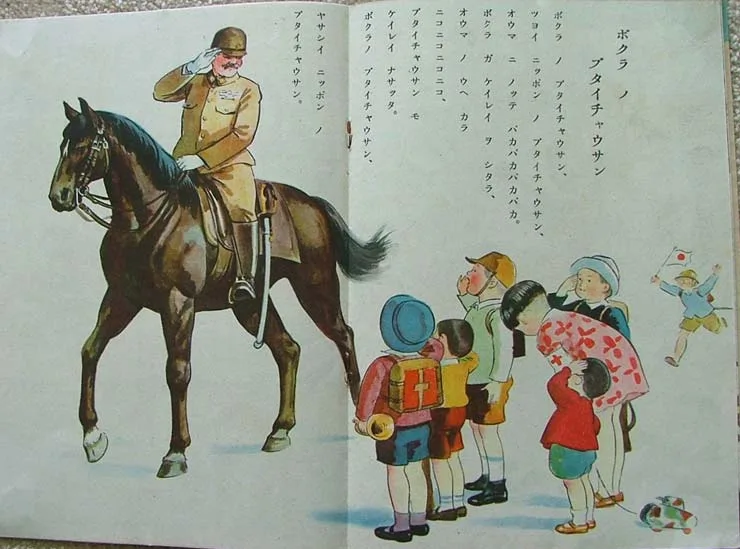
Our Commander is a strong Japanese Commander.
He rides a horse, clip-clop clip-clop.
When we saluted him, he smiled from atop the horse, and saluted back to us.
Our Commander is a friendly Japanese Commander.
New Hope for the World
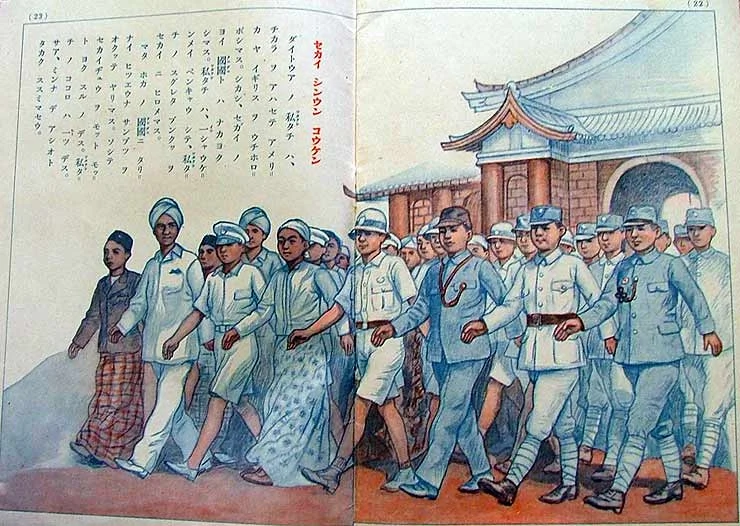
We people of East Asia have destroyed America and Britain with our combined strength. However, we are friendly with the good countries of the world. We study together and spread our superior culture over the world.
We will give other countries the products they need. We will make the world a much, much better place. We are of one heart. Let’s walk together into the future, with our footsteps ringing out.
Sharing Culture
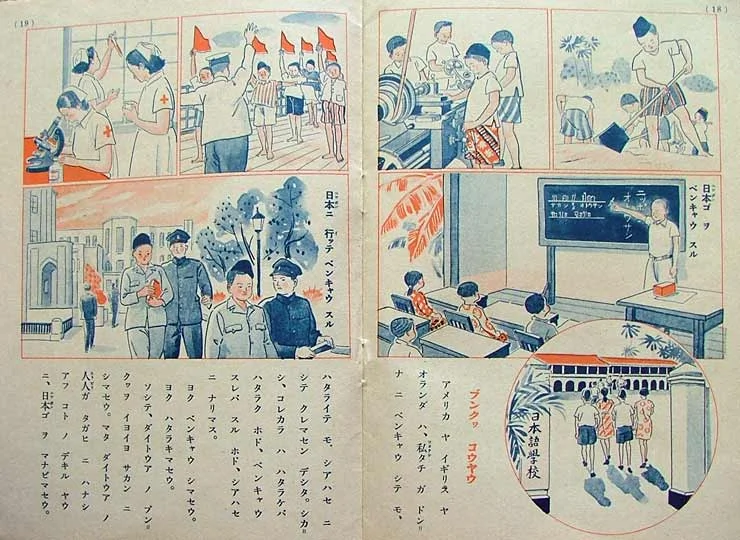
No matter how much we studied or worked, America, Britain, and the Netherlands never gave us happiness. However, from now on, our study and work will bring us happiness proportional to our efforts.
Let’s study hard. Let’s work hard. Let’s make East Asian culture flourish. And, so that all the people of East Asia can speak together, let’s learn Japanese.
Captions
Numbered right-to-left:
1. Studying Japanese
2. Going to Japan to study
The sign on the gate in the circular picture says: “Japanese Language School”.
Co-existence and Co-prosperity
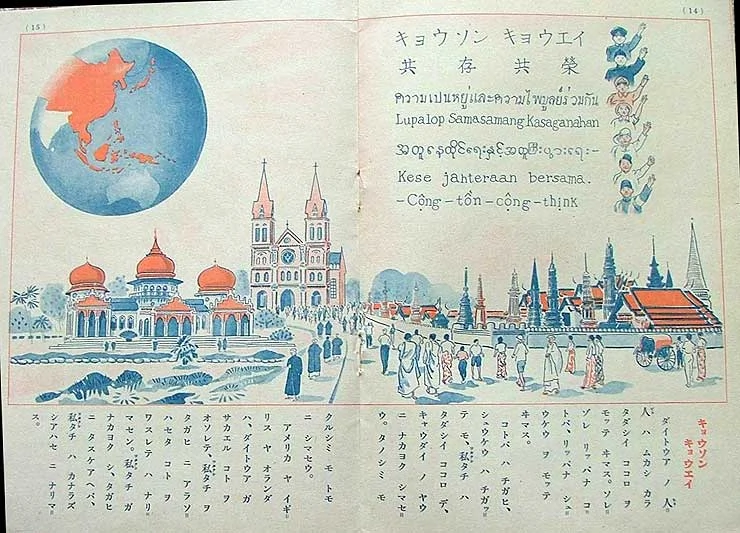
East Asian people have always had a good attitude. There are many wonderful languages and religions.
Even with our differing languages and religions, let’s adopt a good attitude and be friendly like brothers. In happy times and sad, let’s be friends.
America, Britain, and the Netherlands were scared of East Asian prosperity; we must not forget this undeniable fact. If we have good relations and help each other, we shall definitely be happy.
2005-08-16 11:26 UTC. Comments: 10.


Kyle
Wrote at 2005-08-16 18:32 UTC using Opera 8.02 on Windows XP:
Thanks for your translation. I enjoyed reading it, and I think yours is smoother than mine. Your layout is nice, and is a good example that I hope to learn from as I change my focus from writing about living in Japan (I just moved back to the US) to blogging translations for Boing Boing and Slashdot.Xiangdian
Wrote at 2005-08-17 23:29 UTC using Internet Explorer 6.0 on Windows XP:
It actually calls back a painful history for East Asian people, reads funny but apparently they’re shits between lines because “Co-existence and Co-prosperity” is a big lie, 35 millions Chinese lost their lives in the war against Japanese army. 60 years later – today, young or old people in some areas in China still get hurt from fungi pollution made by Japanese 731 troop. So how could I read such a funny story with a relaxing mode? Never!Anyway, Paul, thanks for translation, well-done!!
Takeshi
Wrote at 2005-08-18 03:59 UTC using Firefox 1.0.6 on Windows XP:
> XiangdianLet me point out one thing.
You said
> 35 millions Chinese lost their lives in the war
But your ambassador said 35 millions were “dead and the wounded” in the symposium on 8/11/05.
http://www.china-embassy.or.jp/jpn/sgxx/t207082.htm
Do you think there is a mistranslation in the above site? I am not complaining about your opinion, however, wrong data leads misunderstanding.
mcic
Wrote at 2005-08-18 20:20 UTC using Firefox 1.0.6 on Windows XP:
Thank you for the excellent translation of the pictures on 2bangkok.com. Oddly, imperial Japan’s invasion during WWII brings to mind today’s aggressions in the Middle East – in particular, America’s invasion of Iraq and their belief that its (supposed) values of “democracy” would be welcomed.Asia’s experience sixty years ago show that invaders are never welcome. It’s a shame we haven’t learned anything from history!
Btw – Takeshi and Xiangdan – it seems like Takeshi’s figure is right (it’s also quoted on http://www.china.org.cn/english/fetures/WWII/134377.htm) but either way, the figure is an incomprehensible act of supreme evil.
Too bad, continuing selective interpretation of history by both Japan and China means that the smallest of issues causes great problems – but on a more positive note, at least many Chinese and Japanese on an individual basis are learning from each other – learning each other’s languages, and enjoying each other’s food, music and so on…
xiangdian
Wrote at 2005-08-19 02:27 UTC using Internet Explorer 6.0 on Windows XP:
Thanks Takeshi, for pointing out the figure in time that could create misunderstanding, as I’ve doulble checked on official statistics for WWII, just like mcic said, yours is right. Sorry for my error!By the way, the fact is I was deeply attracted with Japanese language during the discussion with Paul at the very beginning I met him, just like I was exciting into learning ancient Chinese poems in childhood. Thanks our friend Paul providing this platform of communication. Hope it continues in the future…
william
Wrote at 2005-08-22 14:52 UTC using Firefox 1.0.6 on Windows XP:
This booklet is valuable for the ones never experienced the war to read. We must remember the lesson learned from the history.Paul Battley
Wrote at 2005-08-22 15:17 UTC using Firefox 1.0.4 on Linux:
Yes, we certainly should learn lessons from history: as mcic pointed out, the distaste for history among our current crop of politicians worldwide leads them to repeat old mistakes, and to make errors which could easily be avoided.However, I think it’s also important not to use old propaganda like this to bash the Japanese people. Most of them are too young to have been alive during the war and the colonial period. And even of those who were alive then, the majority would have been children at the time and therefore suffered from the depradations and scarcity of a war they had nothing to do with. The people responsible are long dead.
I think that the American occupation of Japan also significantly impeded Japan’s ability to own up to its wartime atrocities: in their haste to restore the country as a Western bastion against Communism, they helped to rehabilitate many of those who had been implicated in the war.
It’s entirely understandable that people in countries badly affected by Japanese occupation want to blame the Japanese for their country’s actions. But I think that the Chinese education system and media overemphasise history as much as their Japanese counterparts underemphasise it. That’s not to say that it should be forgotten, any more than the Shoah should.
At some point, however, there must come a time to stop the hatred and rhetoric. It’s not really helping anyone. And, importantly, remember that propaganda still exists today. Today, one can see the absurdity of the Japanese propaganda above, but how many people believed it at the time? When the media stir up anger, stop and ask yourself why. What is it that they want to distract your attention from?
joe
Wrote at 2006-08-31 10:51 UTC using Internet Explorer 6.0 on Windows XP:
do you have a picture of Japanese navy?Paul Battley
Wrote at 2006-08-31 18:44 UTC using Firefox 1.5.0.6 on Mac OS X:
Try Google Image Search, Joe. Here’s a search in Japanese, for ‘日本海軍’; here’s a similar search for ‘Japanese Navy’ in English.awesomej
Wrote at 2006-11-29 05:53 UTC using Firefox 1.5.0.8 on Mac OS X:
thanks for your translation paul, I used it as part of a small sociolingustics project, it was a great help, my Japanese is not excellent. You’re properly cited and all, so I hope you don’t mind. I don’t know if you’d be suprised, but it’s rather hard to find things like this. I was mad I couldn’t track down the owner, most of the easily accessible japanese propaganda is in English, what a pain…—j